
A Letter from Dingo Dany
Aspen and the Magazine in a Box

For a visitor in 2026, the town of Aspen offers a very specific tourist experience. Over 70% of the city’s revenue comes from tourism that the Aspen Snowmass Ski Resort attracts. All the infrastructure of the town collaborates with this means to an end. To get there, you will travel up Interstate-70, a stretch of road that is infamous for traffic congestion and high-speed crashes, but the views are to die for! If you would like to go to Aspen for a weekend ski-trip, you will first need a lift ticket. You may not go skiing without one. One day is $264. In addition, you may rent your gear including skis, poles, boots, and a helmet for $131.99. For lodging you may pay from $229 all the way up to the most luxurious hotels for $2,400 a night. Of course there are plenty of things to do. You may only ski one day, but as the Aspen Snowmass website guarantees there is “just as much variety in its shopping as in its terrain…a shopper’s paradise” From Prada, Gucci, Ralph Lauren, and Valentino, those in the know “won’t leave without taking in some shopping.” For dinner you can get a $25 hamburger to eat with your $150 ski goggles still on. Or perhaps make the lobster’s trip up the canyon worth it and get some surf and turf! But don’t forget to round up 4-5 of your closest ski buds (save one to take the video) for a “shotski” of your favorite liquor between $16-451 per person.

Aspen wasn’t always this way. After the Silver Mines shut down in 1893 the town was essentially abandoned for lack of economic opportunity. The “quiet years” of Aspen saw significant population decline, but the landscape still inspired the few and wild to move there in search of freedom and convergence with nature. A fringe culture of artists, architects, writers, and explorers characterized Aspen. But by the late 60s into the early 70s, the town was on the precipice of a changing identity. A hedonistic paradise by reputation, more and more counter-culture voices visited Aspen for creative refuge. The town was gaining notoriety and in 1961, the first portion of Colorado’s Interstate-70 opened to traffic, setting in motion the very industry that would commodify and transform the land and culture of Aspen into the antithesis of freedom of exploration.
Here a score of families had built their own Walden, leaving the creek, meadows, and mountain vistas unscarred. Now through their midst and their view roars the Interstate, a vast expanse of paving and tunnels, bristling with road signs, bordered by bare earth and boulders, all surrounding trees and shrubbery having been bulldozed and burned.
-Aspen no. 2, 1966
Then during the 1970 mayoral race, Gonzo-journalist Hunter S. Thompson ran for Sheriff of Aspen using a radical “Freak Power” campaign. He proposed changes to the town like replacing all the paved streets with sod paths, legalizing recreational drugs, limiting hunting and fishing licenses to residents only, abolishing the use of guns by the police department, maximizing punishment to those who commit “landrape” and even changing the name of Aspen to “Fat City” to prevent further opportunistic development of the land.
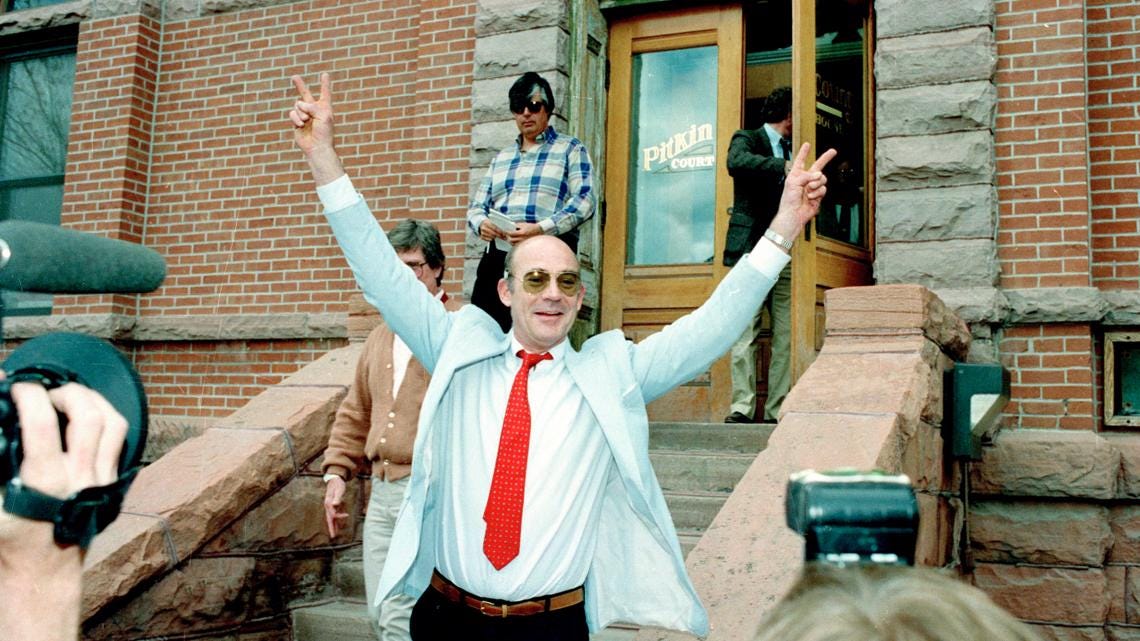
Of course, Thompson lost that race, paving the hot asphalt road for the conservative candidate to develop Aspen into the tourist destination we know it as today.
Before the four-lane highway, before the mass infrastructure, tourism, ski lifts, and Gucci bags, before Hunter S. Thompson and the battle for a mountain town’s identity—Phyllis Johnson visited Aspen, Colorado, and asked herself, “Why?”
Why, for example, couldn't a magazine come in a box? Why shouldn't an article exploring jazz be accompanied by an LP record illustrating in sound our words in print? Why couldn't each article be a separate booklet, in the shape, color and paper most appropriate to the subject? We kept asking why for months. Aspen magazine was the answer.
-Aspen (August 1966 advertisement)
Formerly an editor for Women’s Wear Daily, Johnson spent most of her life in the New York advertising scene. In 1964, with a couple of her friends, Johnson got the idea for a “multimodal magazine” while enjoying the sun and skiing in the unique cultural climate of Aspen, Colorado. Like the city of Aspen, Johnson wanted her magazine to showcase culture and play. Therefore, Aspen: The multimedia magazine in a box was printed, distributed, and serialized in 10 issues from 1965 to 1971 by Roaring Fork Press in New York City.
The point of the box was to think outside of the box. Johnson wanted a subscription that served as a time-capsule of a particular moment and place, “covering everything that enhances life and anything that can be described as a civilized pleasure of modern living.” Each issue had a theme which spanned from the town of Aspen itself, to PopArt, psychedelic drugs, and Japanese culture. Johnson’s magazine was multimodal in every way: essays, art prints, flip booklets, phonograph recordings, postcards, film reel, flower seeds and even 3D samples in lieu of printed ads could be found in each subscription.
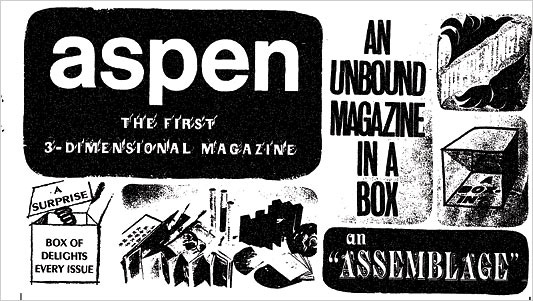
Mostly distributed across New York, an Aspen Magazine subscription could have been sent anywhere across the United States. It was $4 per magazine or $16 for a yearly subscription.
Each box was drastically different from the other: it was designed to be that way. The contents of the magazine could have been contained by hinged boxes, folders, LP sleeves, scrolls, and laundry detergent boxes. Major contributors included Andy Warhol, Roland Barthes, Benno Friedman, John Lennon, Yoko Ono, John Cale, and a wide variety of New York “It” artists who defined the psychedelic avante-garde epoch of the 60’s and 70’s.
Why do we call it Aspen? Because we're using that cultural spa of the Rockies as a point of view, a state of mind, a symbol of the free-wheeling eclectic life.
-Aspen (August 1966 advertisement)
Despite its popularity, Aspen Magazine folded under the pressures of regulation when the U.S. Postal Service “revoked the second-class mail license granted to newspapers and magazines.” Without a license, Johnson could no longer afford the postage it took to distribute the magazine and it ended after six years with Issue 10. It was the very multimodality of Johnson’s magazine, its “un-classifiable-ness” as a magazine which disqualified it and led to its untimely cancellation.2
Now, after the total eclipse of tourism across the Colorado landscape, after the exploitation of land-use regulations for profit, after the commodification of our national parks, the death of print media—after the CSU Library’s Special Collections gathered every issue of Aspen Magazine in their Book Art Collection—a grad student named Dingo Dany will go on a spring break vacation to Santa Fe and ask herself, “How?”
How could a word ever represent something completely? How can an image assist, or a sound? How do we capture the ever changing temporality of a place as we pass by it? How can we possibly distinguish the characteristics of our new world when all the moving parts change so rapidly?
How can a road trip to Santa Fe in 2026 possibly be in conversation with a vacation to Aspen in 1964? How do you write an essay in a box?
Perhaps you embrace everything and save it all up. For in calling it a magazine “we are harking back to the original meaning of the word as a storehouse, a cache, a ship laden with stores.” In calling it an essay I recall the original meaning of the word as a try, an attempt, or a test to explore the boundaries in which we may communicate with an object and think outside of the box.
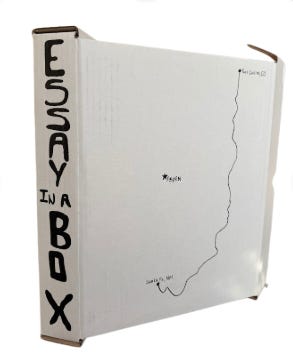
This is the first post in my “Essay in a Box” series meditating and interacting with Aspen: Magazine in a Box. The forthcoming pieces have been created originally for my grad class, E630 “Words and Image” Thanks!

All estimated costs have been pulled from https://www.aspensnowmass.com/
I learned a lot from reading this, had no idea about the Aspen magazine in a box!! (Nor the history of Aspen) Very creative! Your essay is wonderful; thank you!
A lovely read! Can’t wait for the next one in the series!!!!!!